






Transparency Reports
The European Digital Services Act (DSA) represents a milestone in the regulation of the digital space. A key addition to this regulatory framework is the Implementing Regulation specifying the rules for so-called transparency reports under Articles 15 and 24 of the DSA. Transparency reports must be published on websites of all providers of intermediary services that are medium-sized or large enterprises under the Recommendation 2003/361/EC.
The Implementing Regulation standardises the format, content, and periods for transparency reporting. In particular, it specifies in detail the form of templates, including the categories of reported information. All information relating to transparency under the DSA regulation can be found here.
Transparency objectives and obligations
The DSA is designed to promote transparency and social responsibility of digital services in the EU. One of the measures to achieve this is the obligation for providers to publish transparency reports, in which they describe, in detail, all their content moderation practices. These reports must contain specific categories of information depending on the type of provider, such as:
- Amount of user content removed,
- Accuracy of automated content moderation systems,
- Number of user accounts removed,
- Information on content moderation teams.
Harmonization of rules and templates
The Implementing Regulation standardises the format, content, and reporting period. Here you can find report templates in XLSX format (Annex I), instructions for completing the templates (Annex II) and the Implementing Regulation in PDF format. According to Articles 15, 24 and 42 of the DSA, the obligations regarding the publication of transparency reports are not the same for all providers of intermediary services. Therefore, not all sections of the templates apply to all types of service providers. The first column of the templates always indicates the type of service provider to which the relevant request applies. While filling in the cells, CTU recommends using the following key: If the situation occurred, enter the relevant number. If the situation did not occur, but could have occurred, enter 0 (e.g. the provider did not receive any orders under Article 9 of the DSA in the given period). If the situation could not have occurred, i.e. the provider does not perform this activity at all, leave the cell empty.
Reporting period and timeline
After the Implementing Regulation enters into force on 25 November 2024, in accordance with Article 2 of this regulation, the relevant providers of intermediary services, providers of hosting services, providers of online platforms, VLOPs or VLOSEs shall publish their transparency reports no later than two months after the end of each reporting period. VLOPs and VLOSEs are required to publish these reports twice a year, while other providers only once a year. Providers are required to start collecting data as required by the Implementing Regulation from 1 July 2025, with the first harmonised transparency reports to be published in early 2026.
Annex II, Transition Period Timeline
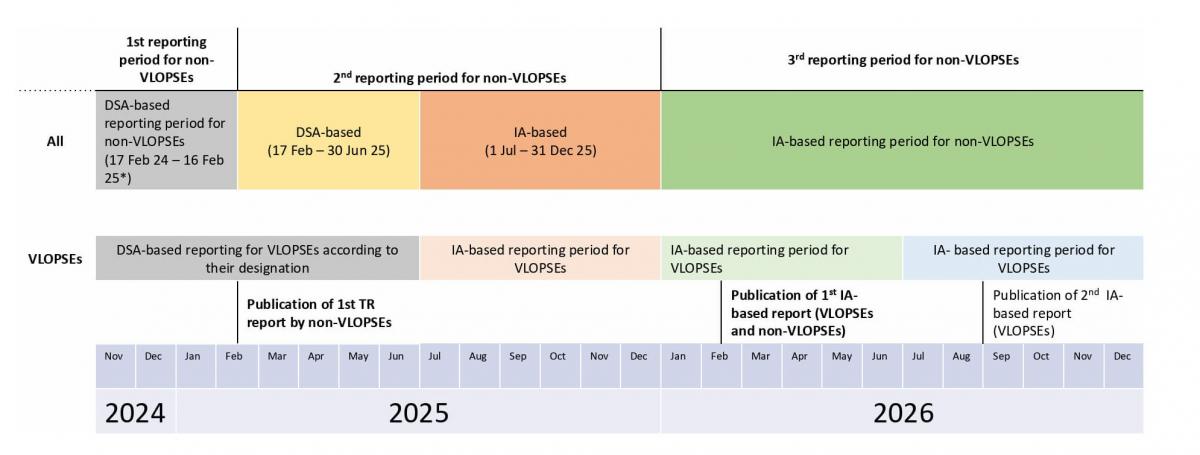
Transition Period, see Annex II
-
Current year before the Implementing Regulation is published.
- Operators who are not VLOPs/VLOSEs shall publish reports from 17 February 2024 to 16 February 2025. When composing the transparency reports, providers shall follow Articles 15 and 24 of the DSA only.
-
From 16 February – 30 June 2025
- When composing the transparency reports, providers shall follow Articles 15 and 24 of the DSA only (however, we recommend using the template already).
- From 1 July2025, the transparency reports must follow the format set out in the Implementing Regulation.